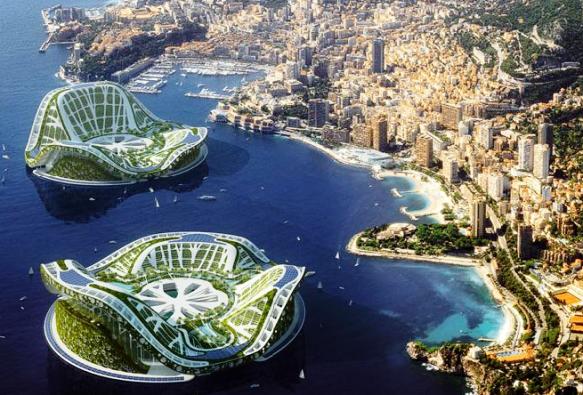
This is the third post I write about seasteading, and probably It will not be the last one. A lot of architects and scientists are thinking about the possibilities of creating cities on water, thus, a bunch of utopian projects are developed to make us dream about an interesting future. However there was one man that almost saw his seasted being constructed.
Buckminster Fuller was a brilliant visionary, scientist, environmentalist, and philosopher who, in the 1960s, received a proposal from a wealthy Japanese patron called Matsutaro Shoriki, to design a floating city in Tokyo Bay. It was called Triton, and was intended to has a shape of a tetrahedron that measured two miles on each side, and capable to host 5000 residents. Shoriki died in 1966, but the United States Department of Urban Development was aware enough to start to support the Fuller's project.
"His designs called for the city to: be resistant to tsunamis, provide the most possible outside living, desalinate the very water that it would float in for consumption, give privacy to each residence, and incorporate a tetrahedronal shape which provides the most surface area with the least amount of volume. Everything from education to entertainment to recreation would be a part of the city. Fuller also claimed that the low operating costs would result in a high standard of living."

"Schematics for Triton were sent to the United States Navy's Bureau of Ships, to check it for 'water-worthiness', stability and organic capabilities, then off to the Bureau of Yards and Docks to see whether or not they could even build this thing, specifically at the cost they had projected. Both Bureaus gave the thumbs up, and the Navy's cost estimate came within 10% of Buckminster's. And that's probably the craziest part of Triton: At every stage, it was going to work."
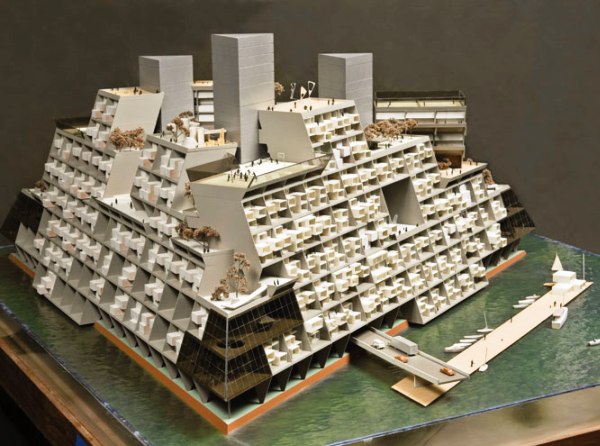
After the scientific approval of the project, the city of Baltimore tried almost everything to put Triton City in Chesapeake Bay. However, because of administrative instability and bureaucracy, Fuller got tired of waiting for approval, and just gave up. A scale model and a book with Fuller's plan are in American museums today, to remember the moment in which magic almost happened.
Buckminster Fuller was a brilliant visionary, scientist, environmentalist, and philosopher who, in the 1960s, received a proposal from a wealthy Japanese patron called Matsutaro Shoriki, to design a floating city in Tokyo Bay. It was called Triton, and was intended to has a shape of a tetrahedron that measured two miles on each side, and capable to host 5000 residents. Shoriki died in 1966, but the United States Department of Urban Development was aware enough to start to support the Fuller's project.
"His designs called for the city to: be resistant to tsunamis, provide the most possible outside living, desalinate the very water that it would float in for consumption, give privacy to each residence, and incorporate a tetrahedronal shape which provides the most surface area with the least amount of volume. Everything from education to entertainment to recreation would be a part of the city. Fuller also claimed that the low operating costs would result in a high standard of living."
"Schematics for Triton were sent to the United States Navy's Bureau of Ships, to check it for 'water-worthiness', stability and organic capabilities, then off to the Bureau of Yards and Docks to see whether or not they could even build this thing, specifically at the cost they had projected. Both Bureaus gave the thumbs up, and the Navy's cost estimate came within 10% of Buckminster's. And that's probably the craziest part of Triton: At every stage, it was going to work."
After the scientific approval of the project, the city of Baltimore tried almost everything to put Triton City in Chesapeake Bay. However, because of administrative instability and bureaucracy, Fuller got tired of waiting for approval, and just gave up. A scale model and a book with Fuller's plan are in American museums today, to remember the moment in which magic almost happened.


(citations taken from here and here)
(the book "Study of a Prototype Floating Community" in Amazon)